

I. Another way of talking

For me sex has always been a way of communicating. The verb comes from the Latin communicare, to put something in common, and few things get as shared as that. It isn’t my only way of dealing with people, but it’s the oldest, and I don’t remember who taught it to me, just as you don’t remember who taught you to speak. From thirteen until the day of diagnosis it was the centre of my life. Then it slipped into the background. Today it’s fundamental again, without being the centre.
I want to tell it, and I know there are two approved ways of doing that. One is the confessional style, with its contrition, which in Latin means to be crushed, ground to dust, and at least forces you to weigh the damage. The other is the pamphlet style, with liberation and empowerment, which gets it right that desire isn’t a shame and leaves all the painful bits in the ink‑well. Either works fine. I’ve lived too long to be satisfied with just looking good.
I’ve had hypersexuality for many years, and it’s taken me to places and people of every class. Some of those places were hell. Others were the closest thing to happiness I’ve ever known. I’m not going to sit on the fence.
Sex has been my oldest way of talking to other people; it was taught to me untimely by men who had no right to, it was switched on and off by a built‑in switch that comes with my illness, and yet it has given me the most human and magical moments of my life, the ones I won’t apologise for, because apologising would be denying myself.
II. What they did to me

I’ve already written on this blog that I suffered abuse from thirteen to eighteen. Five years. I’m not going to repeat it. I’ll just add how it started. I began watching porn very early, on the internet, which back then was a lightless wasteland. In quotes, I was looking. And then some adult men found me: a chubby, lonely kid with parents splitting up and nobody at home watching what he was doing on the computer. Let me make this clear once and for all: looking isn’t consenting. The seeker asks for something. The finder decides what to give.
What they gave me wasn’t just anything. They were violent, hard practices that did a lot of damage to my head and my sex life. When people ask what triggered my bipolar disorder I answer that the weapon came from the family, but they pulled the trigger. What I did afterwards is mine. They stole the beginning; the rest I’ve written myself, with my mistakes and my hits, and I won’t let them have the pleasure of still being listed as authors.
Every time I tell it out loud I learn the same thing. People get upset when you’re a victim of sexual abuse, especially if you don’t have the delicacy to be discreet, quiet and in another room. It’s happened to me even in mental‑health groups, and if I can’t talk about it in a mental‑health group, they’ll tell me where the hell I should. Here, for example.
Not long ago I heard someone defend, with great conviction, that making child pornography with artificial intelligence would be a good idea. That way pedophiles would get their fix and real children would be left alone, because a fabricated image contains no child. It’s the old catharsis theory, the Greek purge: what’s let out goes away. From what I’ve seen, read and lived, it works the other way round. Porn doesn’t soothe desire. It feeds it, because it gives images to the imagination, and imagination grows when it eats. I know this from both ends. I was the material.
III. A map that wasn’t mine

What I’ve never mentioned on the blog is porn. For decades it was the bulk of my sexual life, far more than any bed, and it would be a fraud to write this essay and skip it.
Porn teaches. It doesn’t force anything, but it teaches what to desire, and it teaches by steps. You start watching normal people having sex and end up seeing staggering stuff, because yesterday’s stuff today does nothing to you. That’s called habituation: a repeated stimulus gives less and less response, and demands something a bit further. That blows the whole catharsis apart. What’s let out doesn’t go away. It’s spent, and you have to replenish it stronger.
They’ll tell you you can tell the difference between what you see and what you want. True, but you only know that afterwards. Many of the things I did in bed would never have occurred to me if I hadn’t seen them first on a screen. Some I could do without, and I left them without missing them. Others I really liked, and I keep those without asking anyone’s permission.
The problem with porn isn’t the sex, which is among the best there is. The problem is that it arrives before life and hands you a map, and a teenager who learns to desire with a foreign map spends years figuring out where he actually wanted to go. I spent half a life. But I did it, and what’s left is mine.
IV. The Switch of Lust

One day someone said in a conversation that there ought to be a switch for human lust. I replied that bipolars already have one. Not the reproductive one: the lust switch, the libido switch, the desire switch. The bad part is it’s involuntary. It flips itself, and has a special talent for doing so at the worst possible moment.
It turns on in mania. Manuals call it hypersexuality and list it among the most typical symptoms of the phase, so normal it’s normal. It doesn’t always happen, and I’ve been in mania without it, so the switch isn’t soldered to the phase. In depression it shuts off completely. It’s a blackout of the old days, with no emergency light.
The complaint is older than psychiatry. At the start of the 5th century, in Book XIV of The City of God, Augustine of Hippo complains about a member that doesn’t obey the will as the hand or foot do: it moves when nobody asked it to and leaves the asker hanging. He explained it as a custom‑made punishment. Man disobeyed God, and since then flesh disobeys him. If the saint is right, the switch comes pre‑installed in everyone. My illness only adds a hand that isn’t mine.
Hypersexuality lasted me until the diagnosis and coloured my whole life. It cost me many relationships. I fell madly in love and wanted genuinely, but sex always derailed me: it made me cheat and put myself and the people with me at risk. I tell it without a whip, as one tells a fever. Fever isn’t the patient’s opinion. But anyone who’s had it knows that, between delirium and delirium, you see things sane people never see.
V. The Turn

Bipolars have a word that sounds nautical to everyone else: the turn. It happens when a depressed person who is actually bipolar is given antidepressants with nothing to hold them down. It doesn’t climb slowly to okay. It does a hard‑steer and lands in mania. The English medical literature calls it a switch, literally a switch. Doctors already had the figure for this essay. They had it in another language.
Mine, the big one, was ten years ago. A week and a half of antidepressants, not even two, and my mania had already kicked in with all its factory‑fitted gear, lust switch included. Nobody knew I was bipolar yet, starting with me. And you need to understand one thing: seen from the inside, mania doesn’t feel like an illness. It feels like finally being right.
Since then the turn has been a temptation, like the smell of tobacco to someone who’s quit. When depression tightens and the meds do nothing, the worst idea pops up: binge antidepressants until I get a turn and a hypomania, a small‑scale mania, which at least means I’m alive. It’s the only way I know to move an involuntary switch by will, and that makes it the worst. I’ve thought about it more than once. I put it here because that too is desire: the urge to have urges again.
VI. The Happiest Year of My Life

There was a phase, the one of clubs, parties and shared beds, when I did things that even demons would have found disgusting. Some pious soul would call it aberration, Latin for straying from the path, as if the path were the same for everyone. I had a blast. It was probably the highest I’ve ever reached in terms of pleasure, and that’s saying something because I love shagging in the most normal ways possible.
I can’t regret that phase, because it was so beautiful and pleasurable, and I felt so bonded to the people around me that apologising would be denying myself. It was the happiest year of my life.
I know what a bipolar is expected to say about those years. That it was the illness, that that wasn’t me. It’s a kind phrase, and it carries a grain of truth, but not all of it. The illness pushed me, sure. What I found when it pushed me wasn’t just a symptom. It was people: complicity, laughs, trust, bodies that understood each other without a manual. If all that was the illness, then the illness is the author of the happiest year of my life, and I don’t give that authorship to it. I don’t give it to the ones who stole my beginning, and I won’t give it to the illness either. I don’t call it a mistake.
Aristotle would half‑agree with me, which is enough. In Book VII of the Nicomachean Ethics he distinguishes two types. The incontinent acts against what he decided, then repents and is cured, like the epileptic who goes through crises. The intemperate sticks to his choice, doesn’t repent and is incurable. By that classification this essay lands me in the bad box, and Aristotle gets half right: I don’t repent and I stick to it. He fails on the motive. The intemperate sticks because he believes he did right. I stick because repenting that year would be wishing to be someone else, and the damage I did in other times, which I did, isn’t fixed by wishing I’d never existed.
During my first psychiatric admission the girl I was just starting to see came to see me, and we ended up doing it in the bathroom of the ward. As a proof of life it was the most convincing thing. And once, with everything else going to hell, I half‑joked that I could always earn my bread with the skills I learned in those years. The other half I leave to the imagination of the reader.
VII. I focus on the person

Hypersexuals are said to have no criteria, that with the switch on any partner will do. That’s what promiscuous means, from Latin promiscuus: mixed without distinction. Something’s there. But I’ve always focused on the person. Whether a woman is taller or shorter, fatter or thinner, I couldn’t care less. I care who’s in front of me.
I’ve always brushed off the canons, and life has proved me right. I’ve had better sex with women who, according to magazines, didn’t make the canon, than with supposedly “prettier” ones with whom it was worse. A person can be fascinating and a disaster in bed, and vice‑versa, and the one thing that never fails is the conversation before and after.
The first time I met a girl, she invited me to her flat. When I arrived she was on the balcony, reading a book, and I fell in love right there. I’d met lots of girls and never found any reading. Years later I met another, very special to me, also reading, in the Tabacalera. Those two images are clearer to me than any of my wildest nights. For me desire often comes through the other’s head.
And there the switch stops being an explanation. A switch supplies power to whatever’s in the room, whatever it is. It can’t read. The illness gave me the voltage, and sometimes took it away. That I fell for a girl with a book on a balcony was my own doing.
I love women who say what they like, who are fewer than there should be. I’ve met many who didn’t dare talk about sex, not for lack of desire. A woman with desire still gets a raw deal: the man is supposed to want it and the woman is blamed. In Spain things have changed a lot. Talking to recent Latin‑American arrivals I see it’s still a struggle there. A woman who talks about what she wants without apologising is, to me, the most beautiful thing. It’s the people who speak that turn me on.
VIII. When nothing rose
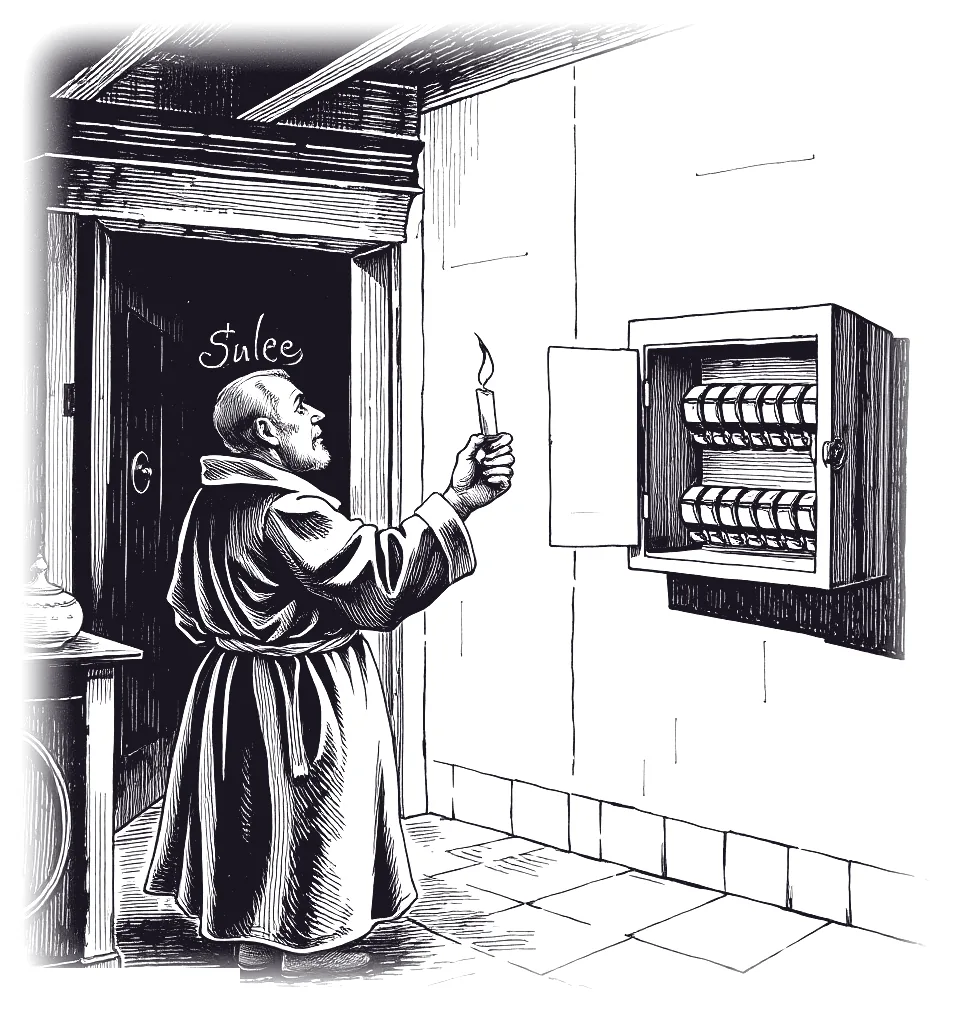
There were years when the switch wasn’t off. It was worse: the fuses had been ripped out, the old‑house breaker gone, and without fuses it doesn’t matter how you flip the switch, because no current gets through. For a long year and a half I had a couple of relationships, one of them a proper partnership, and I didn’t shag once.
I couldn’t. I was blocked, paralysed by fear, and nothing rose. With anxiety and panic lodged in the body it’s impossible to want anything. There’s physiology: erection depends on the parasympathetic system, the rest‑and‑digest one, and fear hands the reins to the other, the fight‑or‑flight one. To have sex you need to be relaxed, and no blue pill fixes that, because the problem wasn’t down low, it was up high.
The body recovers. Slowly and without fanfare, tap by tap, like a house after a flood. I masturbate now and then, because it helps and because I like checking the wiring still works. In Jewish tradition there’s talk of zera levatala, the wasted seed, seen more as a waste of energy than a sin. I respect that a lot, and I’m shaking it off. A bloke who’s gone years without functioning has the right to take inventory now and then.
And for poetic justice I note something I haven’t seen in any treatise. Few things resemble a prosthetic orgasm as much as a good pee after hours of holding it. It’s one of those tiny bodily graces you ought to thank more often.
IX. What I’ve made clear

From all this I’ve drawn a few clear points, and none of them are regrets. Sex is part of life, and a fundamental part. What they did to me as a kid is theirs. What I did afterwards, with my shadow on my back and a switch I didn’t control, is mine, with the bad and the wonderful. And today I want something else.
I’d rather have good friends than a slew of lovers, and even single I wouldn’t consider a lover. I’d consider a partner. I have a healthy, very good relationship with a woman who loves me knowing where I come from. Sex is no longer the centre of my life, but it still matters. In a partnership it unites, and when it’s good it’s the most honest conversation there is. The best nights of my life all started with talking. I don’t live it as a sacrifice.
The switch moves fast: antidepressants shifted mine in a week and a half. Mine has moved slowly. I spent half a life figuring out where I wanted to go. The body comes back tap by tap. Desire is learned, unlearned and relearned, which is the best news the body gives and also the slowest. The temptation of the turn is that rush. Life gives you desire back slowly, which is the only thing the turn can’t do. Life lands a few turns, never better put. You end up at a different destination than you thought, and it turns out it was yours all along. I don’t change a single night I chose, nor the ones that went wrong nor the ones that made me happy. If other things had happened to me I’d be another bloke, with other questions and other people beside me. I wouldn’t be with who I am, I wouldn’t live where I live and I wouldn’t have my cat.
Works cited
- Aristotle, Nicomachean Ethics, Book VII
- Augustine of Hippo, The City of God, Book XIV
- Babylonian Talmud, tractate Niddah